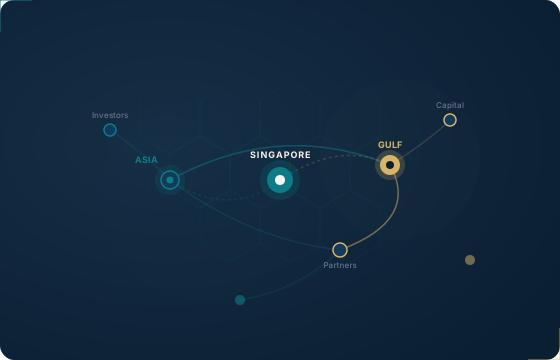
The next phase of Asia–Gulf growth will not be won by generic introductions. It will require practical operating bridges: sector-specific market theses, relevant counterparties, trust-building, JV design, government context, talent pathways and execution discipline.
The volume of capital moving between Asia and the Gulf is significant. Sovereign wealth funds, family offices, development finance institutions and corporates from both corridors are actively looking for exposure, partnerships and operating platforms. The gap is not capital — it is quality of execution.
Successful companies understand both the boardroom logic and the ground-level operating constraints on each side. They invest in relationships before transactions. They understand that what works in Singapore does not automatically translate to Riyadh, and vice versa. They hire people who can interpret policy signals, cultural expectations and procurement logic in each market.
The companies that win will also understand that the corridor is not uniform. Singapore–GCC, ASEAN–Saudi Arabia, China–UAE and India–Gulf each have distinct patterns. Effective operators pick their lane, build deep in it, and create positions that are hard to replicate with money alone.
Key points
- The gap on the Asia–Gulf corridor is not capital — it is quality of execution.
- Successful operators understand both ends of the corridor, not just one.
- Deep, specific positions are more durable than broad presence.
If this affects a current Asia–Gulf decision, Contact Us. To receive future insights, Read Hillblu insights.